"I'm particularly grateful that I was allowed to read the Bible as I read my other books, to read it as story, that story which is a revelation of truth. People are sometimes kept from reading the Bible itself by what they are taught about it, and I'm grateful that I was able to read the Book with the same wonder and joy with which I read The Ice Princess or The Tempest."
- Madeleine L'Engle, Walking On Water: Reflections on Faith and Art
Sunday, March 2, 2014
On the Reading of the Bible

Saturday, March 1, 2014
In Praise of O'Connor
Gene Edward Veith, Jr. calls her "a writer of uncompromising theological orthodoxy" yet "unorthodox in her fictional style." Indeed, I must blame Veith for introducing me to the southern gothic writer Flannery O'Connor in the first place -- and for adding another entry to my favorite authors list. (You might as well blame Veith for "making" me read a lot of what I've read in the past three, four years.)
According to Robert Drake, O'Connor's "overriding strategy is always to shock, embarrass, even outrage rationalist readers." (Haha, I must be a rationalist.) My first read of A Good Man is Hard to Find honestly disgruntled me, and ever since, she has never failed to leave me dissatisfied with the way things are, and that, to my mind, is where the beauty of her writing lies.
When Paul Engle, her teacher at the University of Iowa, first met her, he could not understand a word she said, on account of her native Georgian dialect. I felt the same as Mr. Engle. I couldn't grasp what she was saying, but I knew it was something profound. A read through her first collection of short stories gave me a better picture of what she was saying, and it was an ugly, grotesque, and utterly beautiful picture.
Her stories, as Veith says, are "both funny and shocking." They will easily off-put an immature or uncritical reader, because each story is quite dark, but because of that darkness, the glorious light that flows from her pen is made all the more striking. Her characters will make readers uncomfortable (they have often made me uncomfortable), but that is simply because she is willing, unlike so many modern and contemporary Christian authors, to portray human nature and sin in all of its ugliness. The landscape she paints isn't that of bright, sunny optimism, but that of fallen humanity, and it's just about the most grotesque landscape one can find in Christian literature
But what is much more striking -- although this aspect is often under, but never far from, the surface -- is how she accomplishes the portrayal of God's grace into her writing. She leaves readers "reeling."
An example might be her profound use of irony through profanity. It is no secret that godless people are very likely to invoke God, and O'Connor exploits this brilliantly. In her novel Wise Blood, a character tries to run away from God and goes about seeking the most evil people to hang out with, but he finds himself with a boy who incessantly curses: "Sweet Jesus." And the character finds himself reminded again and again of the reality of God. The "where can I flee from your presence?" reimagined and made much more striking.
Another example is her masterful use of racial tension, for which she has sadly been called racist. In one short story, a man and his grandson go to a big nearby town. The grandfather constantly warns the boy against "niggers," but the boy is much more sensible than that. When they get lost in the town, the boy asks help from a Negro lady, whom he finds utterly beautiful, earning his grandfather's teasing. Eventually, a conflict arises in which the grandfather denies that the boy is his grandson. The grandfather is unable to fix the mess, and the boy doesn't want to. It isn't until they get to a white neighborhood with a lone statue of a black boy that they are reconciled, as they see how they have mutually rejected each other.
O'Connor isn't a Christian author in the sense that one usually thinks of. She was a Christian, in but not of the world. (She once stated: "I write the way I do because and only because I am Catholic." Her faith might not be obvious at first read, but you eventually realize that if she hadn't that faith she would never have written so.) It must be admitted, though, that she has had a much more secular readership than Christian. That really shouldn't be the case. We need more writers like her who remind us of human depravity, and we need more readers who are willing to be reminded of it. Even during her lifetime, she knew this, saying that "most people think of these stories as hard, hopeless, and brutal." I believe they're just absolutely beautiful.
Short Story
This story was my entry to the University of the Philippines Literary Society's Creative Writing Competition last February. It won first place for fiction.
Aside from fixes of a few clerical errors which were pointed out to me, the story is unedited. (Unless someone has tampered with it behind my back.)
(This was my first shot at serious writing after about two years. I'm quite happy with how it turned out.)
THE LAST PAGAN
Aside from fixes of a few clerical errors which were pointed out to me, the story is unedited. (Unless someone has tampered with it behind my back.)
(This was my first shot at serious writing after about two years. I'm quite happy with how it turned out.)
THE LAST PAGAN
“Who is it? What do you want?”
“Uh… I have a message for Professor
H–”
“I am he. Just wait; I shall open
the door.”
The Professor rose from his bed,
unlocked the door, and stared, amazed, for outside stood one like the messenger
of the gods. His hair curled wildly, and his face was firm like stone. He wore
nothing but a cloak – which the Professor recognized to be a chlamys – and a
petasus, a sun cap, and on his left arm rested a short wooden staff around
which two serpents entwined. On the staff’s top was a pair of wings. The
Professor immediately recognized the staff as Hermes’ caduceus, which was often
confused with the rod of Asclepius – but he knew so much better. Excited, the
Professor lowered his gaze, but was disappointed: the man was barefooted; there
were no winged sandals.
“Are you Hermes? Are you sent from
Olympus?” the Professor asked.
“Here’s the message.” The man gave
the Professor an envelope. “Good day, sir.” He quickly left the hall outside
the Professor’s room, the folds of the chlamys rippling, his bare feet making
barely making a sound.
The dumbstruck Professor remained
at his door. He eventually found the sense to follow the emissary god, but found
no trace of him when he exited the hall. He examined the envelope and found
nothing written on it. He opened it with a fingernail. He found a small note
inside. “Administrator’s office. 3 PM,” he read, and inhaled deeply when he saw
the signature: “Zeus, Lord of Olympus.”
“Shall my faith indeed become
sight?” he mumbled to himself, as was his habit. “Shall I finally be vindicated?”
The village’s clock tower told him that the time was about nine in the morning.
“Phoebus Apollo has set forth, and his chariot burns strong,” he muttered. He
suddenly realized that he was wearing only jogging pants, which he wore only
when he felt very lazy – hence the pants were the legwear which he wore most
often. The Professor returned to his room and dressed himself properly.
Three hours later, he ate at the
village’s Common Hall. Its facade was held up by beautiful stone columns, in
the style of 18th-century neoclassical architecture, and little
expense – so he was told – was spared with what was under its roof. Such were
most of the structures of the village, and they delighted the Professor when he
first moved into the village three months before. Initially he had conversed
with friendly, welcoming people at the Hall, but, having found no other person
who had even the faintest notion of the ancient gods, he now sat at a table
which had been recommended to him as a place where one could eat in silence.
Afterwards, he usually rested on a
wooden bench reading a book in the village’s huge, immaculate field for the
afternoon’s length. The field was so beautiful that the Professor, upon his
first sight of it, exclaimed, “Surely this is Elysium on earth!” Stone-paved
paths cut through it. There was a grove in which many relaxed during hot days,
and there were four fountains (godless,
sadly). Birds flew freely, and many field animals which were not considered
pests skittered on the grounds. After some time, the Professor would doze off,
wake up after a few hours, and return to his room to prepare for dinner. Such
was his daily routine, which was broken only on one day each week; on that day he
would meet with a representative from the village’s administration to talk –
mostly about life in the village and occasionally about the gods – and these
conversations would be recorded. He disliked these sessions immensely.
Today, the Professor sat on a bench
near the field’s lake, or the basin in the ground which had been a lake. The
village’s administration had reckoned too many drowning incidents and had had it
emptied of water. The village was quiet, as it nearly always was; its
population was less than two hundred. The Professor found that he had not
brought a book and decided to idle while waiting eagerly for 3 PM. A man was
standing at the basin’s edge, holding a fishing rod. At length, another man,
the much-disliked village doctor, walked up to him, saying, “Hey, John. Caught
any fish?”
The would-be fisherman glared at
the doctor. “Seriously, doc, sometimes I think you’re crazy. And I’m not John.”
The Professor, tired from impatient
excitement, eventually slept. When he woke, the great clock read 3 PM flat, and
he immediately made for the village’s main office. The Professor could not
understand why the administration called its buildings and officers by terms
unsuited for municipalities. He thought that the main office would have been
much more aptly called “town hall”, and that the Administrator should have been
dubbed the “mayor”, but he had never bothered to ask about the matter.
The main office was built in the style of
ancient Greek temples, and its portico was coated so as to give the impression
of a marble-like sheen. The Professor ascended the stairs to the pillared
doorway. He was not greeted by the receptionist
upon entering, or it might be better said that the receptionist was not able to
greet him. She snored instead. “Her mouth looks like a cave,” the Professor
mumbled. Seeing nobody else, he treaded on. The walls of the hall leading to
the Administrator’s office were lined with carved pillars. “They try so desperately
to imitate the pagans,” Professor mused
as he approached the sanctum sanctorum.
“They’ll build the forums, the temples, the shrines, but they’ll do it without the
gods.” He added, with heavy sadness: “The gods are neither welcome nor able to
come back.”
He reached the door of the most
holy place and, breathing in anticipation, opened it. In front of him was a
large desk, and behind it was a huge man – or god. He seemed to the Professor
to be the exact likeness of the great Phidian Zeus at Olympia. His skin was
like ivory. He wore an unshaven beard, and his unkempt hair coiled madly, just
like Hermes. His eyes gazed at – and, perhaps, into – the Professor with an
unsettling yet unfrightening stone-like firmness, again like Hermes. (Perhaps all the gods are like that.) His
colossal frame rested majestically on a great throne-like chair with a wide
window behind it.
The Professor stared silently at
the figure before him, holding his breath in awe. At length, he realized that
he was not doing the proper thing and immediately bowed down, stuttering, “Oh,
great Zeus, Lord of Olympus, I – I beg you: forgive me of my foolishness. I wa
– I was overcome by sheer wonder. You – you truly are as great as the… as the image-smiths of old portrayed you.”
The other responded in a voice like
deep, rumbling thunder, quiet and intense: “I cannot forgive you.”
The Professor prostrated himself
even more, clamped his eyes shut in fear, and remained in that humble position
for a minute. Had he looked up, he would have seen a dark thunderhead
approaching outside the window.
Suddenly, the huge man began to
laugh thunderously, and Professor imagined that the room shook. The Professor looked
up, confused.
After a long laugh, the other said,
“I cannot forgive you, for there is not one fault in your actions.”
The Professor, still prostrate in
obeisance, stared stupidly as the god’s laughter waned to chuckling.
“Come, get up,” said Zeus, having
ceased from laughter. He stood up slightly from his throne and pointed to a
chair in front of the desk. “Have a seat.”
The Professor rose and walked
slowly to the seat.
As soon as the Professor sat, the
god sank back into his chair and said, “I was starting to think you weren’t
coming.”
The Professor did not reply. He was
still giddy with wonder.
“Did you watch the news last
night?” asked Zeus. When the other did not reply, the god tried again to start
a conversation: “What do you think our chances are next game?”
Still the Professor was, except for
loud, conspicuous breathing, silent.
“Would you like anything? Beer
perhaps?” the god asked.
The Professor disregarded the
offer. Finally regaining composure, he said, “It shocks me that the
Administrator of this village is the King of the Gods.”
The other sank deeper into his
throne-chair and was silent.
“That the Lord of Olympus was
sitting and is sitting on a throne in my very village – this is too great a
thing for me to comprehend. Perhaps I shouldn’t be surprised, for the village’s
architecture declares the glory of the gods,” mumbled the Professor happily.
Zeus began chuckling, a soft gurgle
which swelled and blasted into thunderous laughter. “Man, this is better than I
imagined.”
“What?”
“I – hahaha – ain’t the – heeheehee
– Administrator.”
“But – but
this is his office – the
Administrator’s, I mean.”
“Course it is.” His laughter
softened. “It’s the best place to meet in this dump – privacy and all that shit.”
At this, the Professor, displeased
with the god’s use of the expletive (for had never so much as used “crap” in
his life), frowned slightly; he had always expected the gods to be of a better
class, one which employed his idea of a refined manner of speech. “O Zeus, be
not angry, but it would gladden me that you refrain from using such words
during our conversation.”
“I’m sorry,” he said
unapologetically, and his laughter resurged.
Off-put by the faux apology,
Professor asked, “Where is he then, the Administrator?”
Zeus (or the person who claims to be Zeus, the Professor thought as doubts
entered his mind) snorted, and it pealed across the room like a loud, rude
fart. “The Administrator ain’t here. He’s gone, and he won’t ever come back.”
“What do you mean?” cried the
Professor. “Have you done something to him?”
“Sure as hell I done something to
him.”
“What did you do to him?”
The god got off the throne-chair,
and the Professor saw how tall he was: nearly seven feet. The man sank to his
knees, as if he were in a confession box, his chest still well above the desk. “Forgive
me, Father, for I have sinned,” he confessed mockingly. “I have just killed a
man. Took his gun, put it to his head. I pulled the trigger; now he’s dead.”
There was no a tone of remorse in his voice; it bore the insane pride of a
madman. Lightning flashed dramatically in the sky outside the window.
“What?”
“Said I couldn’t do what I wanted
to do; against the rules, he said. Well, sod the rules. He took out his gun – beautiful
little thing – and pointed at me, but I’m too quick. Wonder what he has to say
about the rules now. Haha.”
“You cannot be serious!”
The man stood up quickly and shouted,
“Damm straight I’m serious!” His stone-firm eyes glared. Thunder pealed.
The Professor sat quietly, avoiding
the other’s intense gaze. The thought entered his mind that the huge person could
easily do the same thing to him. He scanned the room for traces of the murder.
Peeking behind the god, he saw that the head of the throne-like chair was
splattered with some blood. After some time, he asked in a low tone, “Where is
the body?”
The man pointed at the open window
behind his chair.
“You pushed him out of it –
defenestrated him,” the Professor stated, breathing heavily.
The other grinned slightly. “Take a
look,” he said, and led the Professor to the window.
The Professor peered nervously out
the window. Just outside lay the dead, sprawled body of the Administrator lying
face down. A puddle of blood trickled from the head, staining his disheveled
black hair. “You have not taken away anything from him – his clothing or
anything else – have you?” asked the Professor. He hastily added: “Aside from
his life.”
The other shook his head. “I ain’t
a thief.”
The Professor was disgusted. After
five seconds, he withdrew from the window and returned to his chair. He stared
at the floor in silent, breathless revulsion.
The other viewed the person he had
murdered for a little longer, closed the window, and returned to his throne.
“The guy was loud,” he said, as if this were a perfectly acceptable
explanation. His voice, at least to the Professor’s ears, had become unlike
rich thunder and, instead, was now horridly nasal, like an old, rusty guitar.
The Professor was now sure that this
could not be the King of the Gods; this man (for he was now certain that he was a man) was absolutely mad. He demanded:
“Who are you?”
The other man laughed again. “It’s
a joke.”
“What?”
“A joke. I ain’t Zeus.”
“You surely aren’t him, for God’s sake!” the Professor furiously
bellowed, now standing. “A guilty conscience needs no accuser, so they say, but
you carry not one ounce of guilt; therefore I shall be your accuser! You are
nothing like Zeus! You are a mess! You are an utterly detestable madman! You
are a shameless blackguard! You have murdered a man who was done you no great
harm. Your offense is rank; it stinks to heaven and to Hades! Cursed is the day
you were born!” The Professor stopped for breath.
The other seemed indifferent towards
the tirade. “Here, this is me.” He reached for his hair and removed it off his
head; it was a wig. “Old mop, haha.
Just did some stuff with it.” He was bald underneath. He did not remove the
beard.
The Professor vaguely recognized
him as one of the village custodians and did not know what to say.
The other man asked, “Want a beer?”
The Professor’s brows relaxed, and
his mouth fell in astonishment. “Did you not hear me?”
The man loudly replied, “Sure as
hell I heard you! What the hell, man? My mother ain’t got nothin’ on you.”
“The guy has a fridge here,” muttered the man.
“Keeps some beer.”
The Professor’s tongue loosened.
“What was the joke that you were talking about?”
The other man opened a small
refrigerator at the near corner. “What? Sorry, wasn’t listening.”
“The joke, what was it?”
“Oh, that. Heck, man, I’m not
Zeus.”
“Is that it?”
“What?”
“You had me come here to adore you,
and my doing so was amusing because you are not Zeus. Is that the joke?”
“Uh… well, that and the guy who
dressed in the shit-ugly blanket – the Hermes guy.” He pulled out two
crystalline bottles steaming from cold.
“Where is he, your accomplice?”
“What? Oh – dunno, rottin’ in hell,
I guess.”
“Did you…?”
“Yes, Father, he’s dead, too.”
The Professor panted.
“The Administrator wasn’t expected though. Apparently
it’s against house rules to play jokes on patients. He wasn’t a nice guy
anyway.”
“What?”
“I… uh… got your file and you were
the craziest nut I’ve ever read about. I read a lot of patient files, but you
take the cake. Just thought I’d have a good laugh. A good joke, you know. Sorry
if it bothered yah, but I guess it isn’t too bad. Nobody seems to do shit here
anyway – oh, sorry, you don’t like that word.
“Anyway, you got in here because
you done the craziest stuff I’ve ever seen. Not just the usual. Your sacrifice
thing at – where was it? – Greece? Damm! You crazy, man.” He placed the two
beers on the table, after which he cursed and muttered, “Where’s the bottle
opener?”
“What are you talking about? What
do you mean by my getting in this place? I moved in here because I wished to.”
The man, finding the opener, asked,
“You know what this place is, don’t yah?”
“It’s a village.”
The man’s face expressed disbelief
for a moment, and he laughed, shaking his head. “You crazier than everybody
else here, you know that? Heck, man, your brain’s a lost cause. They can’t do
much with it no more.”
“What do you mean?”
“It’s a nuthouse, genius.”
The Professor blinked. “Do you mean
a mental institution?”
The man, still laughing, nodded.
A terrible feeling of realization crept
into the Professor, and it quickly engulfed and overcame him. He fell onto his
chair and buried his head in his hands.
The other man opened one of the
beers and took a swig.
“It’s a madhouse,” the Professor
mumbled bitterly. Then, oblivious to everything else, he recounted, mumbling: “Last
summer, I was enjoying a break that professors really should have, but don’t in
reality. I went to Greece, to a temple, and I sacrificed, but I wasn’t able to
complete it. Authorities arrived. Vandalism, they called it, or something of
that sort. I wanted to defend myself, but nobody else wanted to – or some were
willing, but not in the manner that I wished to be defended. Deportation came
after a time. How terrible, isn’t it? I was the only man alive who had the
sense – who’s sane enough – to use the temple for its original purpose, and
they had me plea insanity. Authorities, indeed. I had sensed that there was
something rotten in the state of the world, and these people confirmed it. For
reasons I do not know – or cannot remember – I ended up here, in a madhouse. I
recall that I moved in here of my own free will, thinking that this institution
was something else, but I suppose they’ve done something to me – or I’ve done
something to myself. It’s a madhouse. I’m in a madhouse.” After a few seconds,
he added: “Because I am the only sane person in the world.”
The other man sniggered mid-drink,
and beer spurt out of his nose. Then he laughed harder.
“Ridicule me, if you wish,” the
Professor murmured. “The scoundrels did the same to me – nay, the world.” After
a while, he understood another thing and mumbled, to himself and not to the
other man, “Oh, that’s why he was called the Administrator.”
“Here, man.” He opened the other beer and
handed it to the Professor with his long arm. “C’mon, take it.”
Without looking up, the Professor
received the beer. He immediately forgot his wretchedness, for he was fascinated
with the sparkling, steaming bottle. The silvery glass was mostly opaque, and
the brownness of the beer was barely visible. On it was engraved a peacock
feather stretching from the neck to the bottom. Around it were flowing vines
and more abstract designs, like old French Art Nouveau. There was no brand
name. He rotated it, examining the artistry which was so rare and unexpected
for a beer bottle. “It’s beautiful,” he muttered. He looked at the other man’s
bottle, and it was just like his. The Professor put it to his lips and sipped.
The beer was revolting.
“By Olympus, what is this?” exclaimed the Professor, jerking
the bottle away from his gagging mouth and spitting out what he could. “It’s
horrible! Never in my life have I tasted something like it! It tastes like –
like…” It tasted utterly like crap, but the Professor would not use such a
word.
The other man understood and
mercifully refrained from finishing the Professor’s sentence. “Takes a while to
get used to, ’s all.”
The Professor saw that the man’s
beer was nearly consumed. “You – you are able… to stomach it,” he said, astonished.
“How?”
“Heck, man, it ain’t that bad.”
“I suppose you can only drink it
because it’s just like everything inside you – rubbish.”
The other man scoffed.
The Professor slammed the bottle on
the desk. “It’s a shame that such a beautiful work of craftsmanship should be
used to hold such a vile thing. What evil things reside in the minds of crafty
men! I am glad that I am not a deft man, lest I should find myself in league
with these blackguards. Then again, I always find myself in league with no one
else.”
The other man finished his beer
with quick, rude gulps.
Examining the bottle again, the
Professor said, “It’s rather like a whited sepulcher, isn’t it?”
“Huh… I’ve heard that expression
before, whited sepulcher.” The other man, eyes shut tight, reaching into the
deepest chambers of his insane mind to recall. After a few seconds of strenuous
brainwork, he gave up. “Jesus, I can’t remember.”
The door was unexpectedly opened,
and a girl, about first-grade age, hopped and skipped inside. “Hey! Who are you
guys? Where’s daddy?” she demanded with the matter-of-fact demeanor common to
all women.
Both men did not reply immediately,
perhaps on account of the embarrassment common to all men when faced with a
woman’s matter-of-fact-ness.
“Where is daddy?” the girl asked
again. “Are you guys crinimals?” When neither responded, she said, “I saw some
crinimals on the news last night, but Daddy doesn’t want me to watch news. He
says it’s bad; too many bad people on the news. Are you crinimals? Did you do
something to Daddy?”
The huge man found his voice first:
“Do you wanna see Daddy, girl?”
The girl nodded, matter-of-fact-ness
still on her face.
“For God’s sake, don’t bring her to
the window,” the Professor whispered urgently.
“Come here, girl,” the other man
said, ignoring the Professor’s plea.
The girl shook her head. “No, I
don’t know if you’re a crinimal o’ not, but Daddy and Mommy and my teacher and
my aunt and every growmup I knows says not trust strangers. You’re a stranger,
and I think all strangers are crinimals.”
The man sighed and opened a drawer
on his side of the desk, pulling something out. “I know where Daddy is. I can
take you to him,” he said.
The girl stamped her foot. “No! You bring Daddy to me.” Then her face
lit. “Or maybe I can just ask Miz Linda where he is. She always knows where
Daddy is. She’s his… uh… sercet… uh… sercetrery.”
The Professor heard a click. “Good lord, no.”
“Oh wait, never mind. She’s busy,”
the girl continued. “She’s always busy, so I don’t get to talk to her much.
Maybe somebody else knows.”
“I know where he is, girl,” muttered the other man, and pop went the silenced gunshot.
As the girl fell, the Professor clutched
his head, horrified.
The other man returned the gun,
walked over to the girl, and picked her up, her blood dripping, and she was
defenestrated. The man inexplicably sang “Ring-a-round the Rosie” in his horrible, nasal voice. The thick thunderhead now
covered the sky, and rain began falling, washing the bloody bodies outside the
window.
“What devil did you make a pact
with? To which demon did you sell your soul?” The Professor’s voice seethed
with grief, disgust, and loathing. He was mourning for her, a girl whose only
dirge was a nursery rhyme, although he had only known of her three minutes
before. No one else was around to grieve. His head was downcast, and tears
rimmed his eyes.
Returning to his chair, the other
man scoffed and asked, “Do you know them? Demons?”
The Professor was silent, still
suffering.
“You much more psycho than I
thought.” The man chuckled. “Hell, you know gods, you know demons. What else do
you know?”
“I know a man who has tried to be
both these things, both god and demon. He has failed in masquerading as one,
and he has utterly succeeded in being the other.”
“Are you finishing that?” asked the
other, pointing to the Professor’s unfinished beer.
“Oh, how I would that the gods had
not fled!” the Professor lamented. “How great the loss of man because of his
rejection of them, of their watchful eyes! They that sat on Olympus thought us
fools, and we confirmed that.”
“I’m taking the beer; you ain’t
listening.”
“That girl – I wonder where she is
now.”
The man poured a mouthful of the
awful beer into his mouth and gulped without a grimace. “You know, man,” he
said. “You damm crazy.”
“I suppose I am damned to be crazy, and I am glad, if you and everyone else are
the sane people in this world.”
The man shook his head, sniggering.
“You really should hear yourself, man.”
The Professor could smell the man’s
vile beer-tainted breath. “I do. What I wish is that I could hear nobody else.”
He paused and then valiantly declared, “I wish to fly to the gods – to Elysium,
if they be there; or to whichever realm they now rest.”
“Wait, wait. You sayin’ you wanna
die?”
“What other way is there to flee?”
The man whistled loudly. “You
crazy.”
“I would say the same to you.” He
breathed deeply, knowing that he would be soon be unable to do so in body. “The
gun, please.”
The man picked up the gun and offered
it solemnly to the Professor. “You sure?” asked the man queasily. “Is there…
uh… anything I can do to make you change your mind?”
“What? Would you like to convert me
to the Church of the Good Joke?”
“I just think being in a nuthouse
is better than being dead.”
“I have been in a madhouse my
entire life, for the world is madhouse, and I am utterly sick of it. All the sane
people aren’t in it – or they aren’t part of it.
“For more than half a century, I
have been the only believer of the old gods, although I must confess to being a
poor practitioner of my faith. The gods have done me neither wrong nor good, –
or what people would say to be good –, but it has been a great deal better than
believing in the gods of this age.
“Is the fault in man or is it in
his gods? I do not know, and I do not care. What I do care about is flight: whether
flight to the Meadows of Asphodel and the Lethe or to the happy rest of the
Fields of Elysium, I do not know; it is for the sons of Asterion to judge.”
“You crazy.”
Both were silent for a time. The
Professor recollected the events of his sad life.
After an eternity, the man asked, “Do
you wanna do it yourself or should I?”
The Professor hesitated. “I wish to
be noble enough to die by my own hand, as the noblest of men have done, but I
have not the courage.”
“Shoulda drunk your beer,” the man
muttered. The Professor’s bottle was now half empty – nobody in the room would
have called it half full. “There’s still some more in the fridge if you…” The
man’s voice remarkably died and left the sentence unfinished. The moment was
much too grave, and even he knew that.
After a minute, the Professor
sighed and said, “Fire the gun when I signal you to.”
The man grimly nodded.
The Professor stood and turned his
face from the man. Like a stoic martyr, he walked to the spot where the girl
was killed; the holy ground was marked where the trail of blood started. He
heard the gun click. The rain had now swelled into a loud thunderstorm. “I hear
the summons; the Lord of Olympus calls me.” He breathed deeply. “By Zeus and
the Olympians and all that I hold dear beyond the walls of this wretched
world!” He made a gesture with his hand, and so fell the last of the pagans.
The man walked to the body. “You
crazy, man. You crazy.” The Professor’s face was one of a tired man to whom
rest had been given – whether this was the good or bad kind of rest, the man
could not tell. He picked up the body. “He’s crazy.” He dropped the Professor,
and the body landed awkwardly sprawled on top of the Administrator and his
daughter. The bodies of the three were washed, and there flowed a beautiful
crimson-blue stream of blood and rainwater, but the man did not notice this. He
closed the window and sank back into the throne-chair. He consumed what
remained of the Professor’s beer. “He’s damm crazy,” he muttered, shaking his
head.
The man brought the gun with him as
he left the office. The receptionist had now woken up due to the storm, and the
man shot her. He exited the building and was drenched almost instantly. The
cold, hostile rain pierced his skin, his bones, and his very soul, as if it
carried a vindictive purpose, and, perhaps defiantly, he laughed.
And for the first time in decades,
in centuries, in millennia, Olympus had risen to strike, in fire and water and
lightning.
Ashes, ashes, they all fall down.
Monday, January 27, 2014
A Happy Birthday to My Most "Love-Hate-est" Composer
What a deplorable post title.
This fellow is ridiculous. His music is extremely hard to play, and when you do finally figure out how to play him correctly, the output doesn't even sound difficult and impressive, and that doesn't do too well with pretentious show-offs, of whom I am the foremost.
Anyhow, I must greet him: happy 258th birthday, Herr Mozart.
 (I only call him "Herr" because of Amadeus.)
This fellow is ridiculous. His music is extremely hard to play, and when you do finally figure out how to play him correctly, the output doesn't even sound difficult and impressive, and that doesn't do too well with pretentious show-offs, of whom I am the foremost.
Anyhow, I must greet him: happy 258th birthday, Herr Mozart.
Monday, January 20, 2014
Leithart and Humble Reading
"To read well, we must become as little children." Thus says Peter Leithart in his sublime essay Authors, Authority, and the Humble Reader, in which he presents a theory of authorship and readership based on authority and humility.
Leithart begins by proclaiming the "death of the author" in postmodernism. He argues that postmodern theorists are "challenging the 'authority' of the 'author'." He points us back to a time when "literary theory centered on the concepts of auctor [author] and auctoritas [authority]." To be called an author was "an accolade".
This being in mind, "reading could not be anything but an act of humility -- homage to the auctoritas of an auctor". Leithart argues (and he laments that truisms have to be argued in the postmodern age) that "simply by picking up a book, opening it, and following the words someone else has written, the reader is subjecting himself to the author". Reading fiction and reading it intelligently "requires a humble acceptance of the world of the novel". Leithart calls the "suspension of disbelief" an act of humility. Chesterton wrote that "humility is the mother of giants. One sees great things from the valley; only small things from the peak." It makes everything around us large and magnificent. The humility Leithart speaks of is not mere "let's pretend", but "paying attention to what the author thinks is important". We have to submit to the rules that the writer sets, and we play by the rules because he is an auctor with auctoritas. Not every writer deserves the accolade of auctor, and Leithart argues that we have a responsibility "to judge literature ethically.... Though fiction creates its own world, the book also is an objective presence in our world; the world becomes flesh and dwells among us, and the question must be asked whether this incarnate word is doing mischief or good." There are consequences of reading, and we surely do prefer that they be profitable.
At the essay's end, Leithart assures that, "having humbled himself before the author, the reader shall, quite properly, be exalted."
Sunday, January 19, 2014
Myth
Perfection hounds us remorselessly. - Thomas Howard (Myth: Flight to Reality)Myths have fascinated me since childhood. (I can't remember the first myths I read, although I'm pretty sure I first read about general mythology in an old 1980-something edition of the World Book Encyclopedia.) I read stories about gods, demigods, heroes, monsters, dragons, and cows, and these tales shaped my imagination positively.
Now, some people are adverse to myths -- and fairy tales, for that matter. These people may be well-meaning Christian parents who want to shield their children from "satanic influences" in myths; the atheist who, very properly, scoffs at the notion of a god or something which has not been proven by almighty Science; feminists who attack the unfair sexism of Fairyland, but they all miss the point. Myths have served many roles in human lives, but they were never meant to convert children to Satanism, or to impose theism or deism on atheists, or to convince people to be sexist. Myths might be read -- and are often read -- with no particular purpose other than pleasure, just as children in their blissful ignorance do -- "listen like a three years' child," Coleridge said. I'm thankful that my parents didn't despair over my mythology-reading. The myths I read never made me want to convert to Zeus-ism or join the Church of Odin. G.K. Chesterton writes:
... he who has most most sympathy with myths will most fully realise that they are not and never were a religion, in the sense that Christianity or even Islam is a religion.... though they provide a man with a calendar they do not provide him with a creed. A man did not stand up and say, "I believe in Jupiter and Juno and Neptune," etc., as he stands up and says "I believe in God the Father Almighty".... (The Everlasting Man)Another purpose -- if it may be called that -- of the myth is to satisfy man's longing for perfection. Here enters Thomas Howard, Catholic author and brother of Elisabeth Eliott. He says in his essay Myth: Flight to Reality:
The whole poetic or artistic or mythic phenomenon that we find when we look at the history of human imagination represents, I think the search for perfection.... We all have imaginings of it (some poets would urge that we have memories of it). Perfection hounds us remorselessly. It stands over against every experience we have of nostalgia, frustration, and desire....
Politics, medicine, ecology, and jurisprudence are our efforts to repair the damage.... When we've been allowed to take time from our plowing and fighting and brushing our teeth, we have tried to say something about perfection and our experience of the discrepancy that we feel between ourselves and perfection....
... We are driven by who knows what -- maybe it's the Holy Ghost -- to complain about this discrepancy, to oppose it, and to transcend it.... Myth is one version of this effort.Howard argues for myth's high place in the realm of narrative, saying that "[in] it you will find more or less perfectly manifested what is implicit in all art". He then writes an apologetic for the disengagement of the myth world from our own.
... if we move the world of myth away from the immediate... out of our calendar completely, we disengage it from the fuss of our world, and by thus setting it free from our time, we set ourselves free with respect to it. For time may be the tragic dimension of human experience... the agent and vehicle of change and decay and death. This why poetry and the promise of paradise are so attractive to us. They all offer an escape from time....We don't want the stuff of myths and fairy stories happening in our particular world, Howard says. We don't want storms instantly happening or volcanoes suddenly erupting because the gods are fighting over who gets the remote. Tolkien expresses this, "I in my timid body did not wish to have [dragons] in the neighbourhood, intruding into my relatively safe world ("On Fairy Stories")." Yes, in a sense, myths do happen in this world, but no one really believes that the Titans were first born about 150,000 B.C., or that on the morning of June 17, 1967 the sky-god Horus couldn't let the sun rise yet because the storm-god Set was still having fun flooding Alabama. Erik Christian Haugaard writes:
"Once upon a time" is no time.... In reality... it means "at all times, in all places." ("Portrait of a Poet: Hans Christian Andersen and His Fairy Tales")Even the story like A Tale of Two Cities did not happen in this world. London and Paris exist on Earth, but quite a few of the Tale's characters never lived and breathed on our planet, and for that reason, the world that Dickens created is different from ours.
However, Howard is not defending the myth against those who would merge fantasy and our world; he's defending myth's -- for lack of a better term -- escapism, which he calls "an escape from the unreal, the transitory and evanescent, to the solid and immutable, that is, the real". Howard even makes a good case that most readers, perhaps even avid realism fans, don't actually want stories to be too real, in the sense of worldly tangibility. If a story begins with an all too real description, complete with the exact time, date, address, characters and actions which simply must exist in this world, the imagination feels imprisoned, Howard argues. "The trouble is we know that room," Howard writes. "It's too defenseless against the postman and plumber and electrician, and we don't want them in our midst."
Howard laments that storytellers today are able only "to make their images out of what their world is made of. There has to be some identity of substance between what they make and what we know, so that we can recognize it." However, the stuff of our world can't create high myth; we can't really "get anything huge and wonderful and breathtaking and beautiful", he argues. The world that produced high myths, "those huge worlds of story that are remote from us but terrifyingly close", has disappeared.
... we have decided (sometime in the Renaissance it was and we finished the job in the eighteenth century) to recreate the world. It's a very small one now, limited as it is by microscopes and telescopes and computers, and asphalts parking lots at MacDonald's hamburger stands. And it's a horror. It is, above all, boring, for mystery has fled from it. We have announced to anyone who cares to listen -- and somehow one imagines that angels and elves aren't that enthralled by the information -- that we can explain everything....
By the eighteenth century the myth became sovereign that the analytic and rational capacity is absolutely adequate for unscrambling the mystery of the universe. Somewhere in the process the gods fled. The irony is that in the very effort of modern art to disentangle human experience from the transcendent, human experience turned to ashes.(I have never seen a MacDonald's hamburger stand, but this was the twentieth century.) Howard, just as a good Catholic author should, values mystery and disdains contemporary literary materialism. He does commend authors such as Flannery O'Connor and Tolkien the mythmaker: O'Connor, because, through her striking, grotesque images, has reminded us that things are not the way they're supposed to be and that what we've made from these things haven't been satisfactory; Tolkien, because he has used the "ancient shapes" (because nothing the world had at hand suited his purpose) to create a truer world than what most modern authors have produced. Modern (or postmodern) man has come close to explaining everything they have on hand, but he hasn't found explanations of things which matter. Man still hasn't transcended the mess he's put himself in and, stumbling around in ever-growing darkness, still hasn't a grip even on the shadow of perfection. And until the Perfection incarnate returns and puts the final period this chapter of the story of the world and begins the new and more glorious chapter, man never will taste perfection.
Howard then defends the necessity of myth today. Writers today aren't likely to find in the modern world "an imagery that will suggest the big, real, whole world". He argues that the author would eventually have to retreat to the ancient paths and search for the "heroes and elves and gods". An author, may he be a realist, a poet, or a creator of fantasy, would do himself a great favor in leaving the realm "cold and lethal myth that holds the whole world in a frosty sovereignty" and visiting the realm of the high myth where he might find "images of glory and mystery and romance and deity and heroism". Mythology, whether pagan or the "true" myths of Tolkien, seeks perfection, restoration -- seeks God. Lewis writes in Mere Christianity:
God... sent the human race what I call good dreams. I mean those queer stories scattered all through the heathen religions about a god who dies and comes to life again and, by his death, has given new life to men.Therefore, Howard argues at the essay's end, an excursion "into that world [of myth] [is] never a flight away from reality; they are, rather, a flight to reality".
We would do well, nevertheless, to guard ourselves from forgetting what mythology really is. They are shadows or dreams of reality; they are pictures of the same landscape which may be exactly like the landscape in every detail except that they aren't the actual landscape. Chesterton reminds us, "These things were something like the real thing; and to say that they were like is to say that they were different."
Pagan idolatry, Calvin wrote in his Institutes, stemmed from the knowledge of God which is innate in man. The myths they created of creator gods and heroic saviors betrayed a sorrowful longing for restoration to how things should be. The Word Incarnate -- though embodying everything that a myth should be, everything that mythmakers could only write about -- was surprisingly not myth, and through that Word all the good dreams that God sent man became reality.
Saturday, January 4, 2014
The Gospel and the Fairy Tale
For Christmas I received a book entitled The Christian Imagination: The Practice of Faith in Literature and Writing, an anthology of essays and reflections compiled by Leland Ryken, professor of English at Wheaton College. This has been one of the best gifts I have ever received. I have not finished it, but it has already enhanced my appreciation for literature and taught me new things about reading and writing. (And it might just convince me that realism is on par with fantasy, which is why I avoid the realism section. The first essay on the topic was already good, and I am scared of what follows it.)
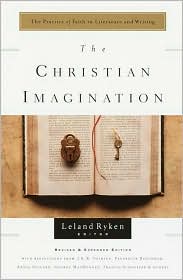
The book is divided into ten parts; each part features essays on a particular subject. I am and have been since childhood an unabashed fantasy fan, so I flipped straight to Part 8: Myth and Fantasy. To my delight, the first selection came from Frederick Buechner's Telling the Truth: The Gospel As Tragedy, Comedy, and Fairy Tale. This particular excerpt was (obviously) the Gospel As Fairy Tale. (I had read about Buechner from Gene Edward Veith, Jr.'s Reading Between the Lines, which is responsible for getting me hyped up about literature in general [I even read the poetry section, despite my dislike of poetry. {Except for Shelley's Ozymandias. Seriously, that poem is good -- and understandable}]. Veith recommended quite a few of Buechner's books, one of which was Telling the Truth. Hence, my excitement.) The Gospel As Fairy Tale begins with a topic familiar to me, (again, due to Veith) the universality, timelessness, and appeal of the fairy tale. Buechner includes a beautiful quote from Tolkien about the fairy tale:
...[the fairy tale] does not deny the existence of... sorrow and failure: the possibility of these is necessary to the joy of the deliverance; it denies (in the face of much evidence, if you will) universal final defeat..., giving a fleeting glimpse of Joy, Joy beyond the walls of the world, poignant as grief.
It is the mark of the good fairy-story, of the higher or more complete kind, that however wild its events, however fantastic or terrible the adventures, it can give to child or man that hears it, when the "turn" comes, a catch of the breath, a beat and lifting of the heart, near to (or indeed accompanied by) tears, as keen that given by any form of literary art.Buechner continues to write of the Joy of the "happily ever after", not as portrayed in spotless Disney Land but that which happens in a dark world akin to ours -- the happily ever after which gives "a fleeting glimpse of Joy... beyond the walls of the world, poignant as grief" which can bring tears to our eyes.
Tolkien's "turn" mentioned in the quote above deserves more explanation, because it is one of his most brilliant concepts. This "turn" is what he calls eucatastrophe, the "good turn", which he believes to be the opposite of tragedy. Tolkien writes in his essay "On Fairy-Stories" that the "eucatastrophic tale is the true form of fairy-tale, and its highest function". He continues to write of the Gospel as fairy tale, a notion that both he and Buechner share:
I would venture to say that approaching the Christian Story from this direction, it has long been my feeling (a joyous feeling) that God redeemed the corrupt making-creatures, men, in a way fitting to this aspect, as to others, of their strange nature. The Gospels contain a fairy-story, or a story of a larger kind which embraces all the essence of fairy-stories. They contain many marvels... and among the marvels is the greatest and most complete conceivable eucatastrophe. The Birth of Christ is the eucatastrophe of Man's history. The Resurrection is the eucatastrophe of the story of the Incarnation. The story begins and ends in joy.Buechner writing on the same point is a vivid storyteller:
Like the fairy-tale world, the world of the Gospel is a world of darkness, and many of the great scenes take place at night. The child is born at night. He had his first meal in the dark at his mother's breast, and he had his last meal in the dark too.... In the garden he could hardly see the face that leaned forward to kiss him, and from the sixth hour to the ninth hour the sun went out like a match so he died in the same darkness that he was born in and rose in it....
In the world of the fairy tale, the wicked sisters are dressed as if for a Palm Beach wedding, and in the world of the Gospel it is the killjoys, the phonies, the nitpickers, the holier-than-thous, the loveless and cheerless and irrelevant.... It is the ravening wolves who wear sheep's clothing.... When Jesus is asked who is the greatest in the kingdom of Heaven, he reaches into the crown and pulls out a child with a cheek full of bubble gum and eyes full of whatever a child's eyes are full of and says unless you can become like that, don't bother to ask.
And as for the king of the kingdom himself, whoever would recognize him? He has no form or comeliness. His clothes are what he picked up at a rummage sale. He hasn't shaved for weeks. He smells of mortality. We have romanticized his raggedness so long that we can catch echoes only of the way it must have scandalized his time in the horrified question of the Baptist's disciples, "Are you he who is to come?"; in Pilate's "Are you the king of the Jews?"... in the black comedy of the sign they nailed over his head where the joke was written out in three languages so nobody would miss the laugh.
But the whole point of the fairy tale of the Gospel, is of course, that he is the king in spite of everything. The frog turns out to be the prince, the ugly duckling the swan.... There is no less danger and darkness in the Gospel than there is in the Brothers Grimm, but beyond and above all there is the joy of it, the tale of a light breaking into the world that not even the darkness can overcome.Returning to Tolkien:
But in God's kingdom the presence of the greatest does not depress the small. Redeemed Man is still man. Story, fantasy, still go on, and should go on. The Evangelium has not abrogated legends; it has hallowed them, especially the "happy ending".These two essays have heightened my appreciation of the Gospels and the story of the Bible as a whole as narrative. They have portrayed the Gospel in a wonderful way -- freshly wonderful. Tolkien's eucatastrophe has altered how I see Christ's first coming in history, and Buechner has beautifully portrayed Christ's work as a fairy story -- or, as Tolkien wrote, a larger kind of story "which embraces all the essence of fairy-stories". Indeed, the fairy tale that is the Gospel is larger and better than all other fairy tales, greater than the legends which it has hallowed, simply because this "tale of a light breaking into the world that not even the darkness can overcome" happened not in a land far, far away, but in our very time-space, and this fairy tale gives us not only glimpses but tastes of that "Joy, Joy beyond the walls of the world, poignant as grief". Tolkien writes:
It is not difficult to imagine the peculiar excitement and joy that one would fell, if any specially beautiful fairy-story were found to be "primarily" true, its narrative to be history.... The Christian joy, the Gloria, is... pre-eminently (infinitely, if our capacity were not finite) high and joyous.
I still have more to blog about, especially on fantasy, and simply need more bursts of diligence to do so. These two essays are a mere 16 pages in this 465-page book, and there is much more to be gleaned. (Although I am not too excited about realism and poetry.)
Subscribe to:
Comments (Atom)